
Executive Summary
Q1 was about turning strong demand into institutional-grade operations. Turtle spent the quarter building the systems that change how we price, bill, and execute liquidity coordination: get paid upfront in stables, open new cashflow streams, make revenue repeatable. The infrastructure we built to run our own business is increasingly the infrastructure we sell.
Q1 at a glance: $92.4M in revenue-generating TVL across Turtle deals. 14 LP deals closed in February alone - a company record. 1,119 total opportunities on the platform, 43 featured. 8,870 active LPs. Sales cycle collapsed from ~45+ days to days. TDC diligence turnaround from ~1.5 weeks to ~2 days. 7 hires across ops and engineering.
The billing engine and Earn revenue-share architecture are in late-stage testing but have not yet processed a full quarter of automated collections. Q2 is the first real stress test at production volume.
Market Context
Turtle's Q1 investments did not happen in a vacuum. The broader tokenized asset market is converging on a set of conclusions that validate the coordination model.
Distribution is the binding constraint. Across the industry, operators agree that scaling distribution matters more than launching new products. The supply side has matured; the gap is in the connective tissue that moves tokenized products into active use. Turtle's entire coordination stack (LP sourcing, campaign design, deposit attribution, multi-frontend distribution via Earn) is built to address this constraint.
Investor confidence depends on structural credibility. Reliable liquidity and redemption ranks first as a confidence driver for end investors, followed by clear investor rights. Yield and distribution incentives rank last. The Turtle Diligence Council, Client Portal withdrawal alerts, and deposit attribution layer are the confidence infrastructure that Turtle had built as an internal tool which we have found the market actively demanding.
Coordination and Compliance are the next meta. Technology is no longer the constraint. Coordination and compliance are. The infrastructure works. The question is whether systems of compliance and tools of coordination catch up. Turtle addresses the coordination side directly through its LP network and coordination stack, and the compliance side through its partnership with Chainlink's Automated Compliance Engine.
Where We Started
Entering 2026, Turtle had over a thousand opportunities surfaced through the platform with steady LP participation. 2025 closed at $2.64M in realized revenue, with material unrealized revenue still to be collected across ongoing campaigns. Revenue was episodic rather than smooth, a function of throughput bottlenecks in legal execution, collections, and attribution rather than pipeline weakness.
The coordination model had demonstrated product-market fit. The constraint was operational: how deals were priced, executed, billed, and monitored remained largely manual. Q1 was explicitly designed to fix this. Build the systems that convert proven demand into repeatable, trackable revenue.
What We Built
Deal Standardization
All Turtle deals have aligned on a standardized engagement format and a clear set of rules as to what we can and can not support. This has empowered our engineering team to build deeper automations around onboarding as the ask from sales is no longer bespoke with each client. We are able to more rapidly close and onboard as result of this initiative.
Desk Structure
We restructured BD and operations into four specialized desks without increasing headcount: Deal Desk (intake, qualification, pricing), Legal Desk (MSA/SOW execution), Diligence Desk (independent analysis via the Turtle Diligence Council), and Liquidity Desk (LP coordination and campaign execution).
The parallel desk structure allows multiple deals to move through qualification, legal, diligence, and execution simultaneously rather than sequentially. The sales cycle dropped from ~45+ days to days. Implementation timelines dropped from ~1 week to hours. February set the company record at 14 LP deals closed in a single month.
Billing Engine
Automated billing was the last major operational bottleneck entering Q1. By quarter end, the TVL-based fee accrual engine shipped and is in production testing, accruing fees against $92.4M in revenue-generating TVL. The invoicing frontend is in beta, targeting full production in Q2. Utila wallet integration is operational with programmatic onchain payments functional. Historical reconciliation via pricing backfill is under final approvals.
Revenue is now tracked and reconciled in real time against a segregated onchain wallet architecture. Revenue timing will remain lumpy in the near term as the new payment format rolls out. The underlying trajectory is clear: the systems are in place to track, accrue, and reconcile revenue in real time. Q2 will be the first quarter with clean, live-traceable revenue reporting.
What this does not yet solve: the billing engine has not processed a full quarter of automated collections at scale. Q2 is the first end-to-end test. If reconciliation issues or edge cases emerge, they will surface then.
Turtle Diligence Council
The TDC is Turtle's first experiment in decentralizing a human operations function. A council of independent analysts produces institutional-grade diligence packets on a ~2-day turnaround, down from ~1.5 weeks. Quality has increased while cost and cycle time have decreased.
The TDC is significant beyond diligence. It provides the independent analysis layer that institutional allocators require before deploying capital. If one human ops function can be decentralized while improving quality and reducing cost, the pattern extends to other functions as Turtle scales.
Q1 Proof Points
Two campaigns this quarter demonstrated the coordination model at scale:
Lighter: $52M+ committed across 354 wallets. Oversubscribed. Average ticket ~$150K. Demand exceeded capacity, validating both Turtle's LP sourcing network and the protocol's positioning.
Decibel: $10M capacity filled across two $5M tranches with a $3M waiting list. Mainnet launched February 26. The $3M waiting list is LP demand Turtle can redirect to future campaigns, compounding the network's value.
Additional Q1 activity: Status Network live with ETH, GUSD, SNT, LINEA vaults (APYs 11-26%). The first non-DeFi-native deal closed this quarter, with many similar structures now in the pipeline. Theoriq DD and vaults launched mid-March.
26 new deals entered the pipeline in March alone. 5 currently in legal, 11 in active negotiation.
Product and Engineering
Q1 saw significant progress across all four product surfaces. Each serves a distinct function within Turtle's coordination stack, and they share data and infrastructure. Seven hires joined across engineering and BD this quarter, strengthening capacity in DeFi indexing, frontend consolidation, portfolio and opportunity surfaces, fullstack product development, Earn distribution, and business development leadership. The DeFi indexing team shipped full historical coverage for four major protocols to production in its first month, an indication of the velocity the expanded team is now operating at.
Turtle Portfolio
Launched in February. Multi-wallet, multi-chain token positions in a single dashboard for LPs. In March, position coverage expanded into DeFi with full historical data indexing for Uniswap, Aave, Euler, and Morpho, all deployed to production in the indexing team's first month. LPs now have a single view of their DeFi positions alongside their token positions, across any EVM chain over any number of wallets.
Portfolio data services become available as a partner API in Q2, creating a new recurring revenue line. Multiple partners have already expressed interest in licensing the underlying indexing infrastructure.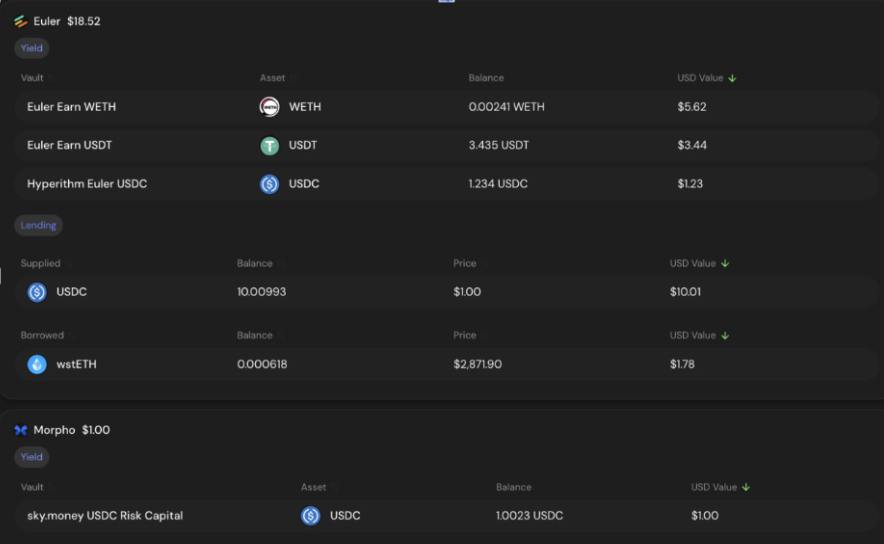
Turtle Streams
Streams is Turtle's programmable incentive distribution layer. It allows any protocol or fund to issue, condition, and audit rewards onchain.
This quarter, Streams moved from internal beta to a documented, externally available product. Security audits by Omniscia and Cantina completed with no outstanding issues. Rewards issuance is controlled onchain through institutional-grade wallet infrastructure, with automated distribution and configurable approval flows. Partners can access and whitelabel Streams on their own frontends via API. Multiple rewards adapters shipped, including conditional whitelisting based on deposit frontend.
A permissionless frontend launches in Q2 with a variable fee on all incentives issued - a new standalone revenue line.
Turtle Earn SDK
Earn enables any third-party frontend - wallets, exchanges, fintechs - to distribute Turtle dealflow and earn programmatic, onchain revenue share. This is the multi-channel distribution layer.
No single distribution channel captures more than a third of expected adoption. The market is multi-channel. Earn is built for this reality - same deal, same attribution, same revenue share, distributed through any frontend without re-engineering.
This quarter we solved the core technical challenges: LP deposit attribution, fee accrual, partner billing, and automatic revenue sharing. The full loop from user deposit through a third-party frontend to that distributor receiving their share of revenue now works programmatically and onchain. This gives Turtle a significant edge over competing aggregator models. Distributors know exactly what they earned and why. Protocols know exactly where their liquidity came from.
In Q2 we are integrating Earn into more third-party frontends, with the aim of generating multiple case studies with real USDC payouts to help onboard higher-value TradFi distribution partners.
Turtle Client Portal
The client portal is where coordination tightens into a closed loop. Clients receive real-time Telegram notifications for deposits and withdrawals made through Turtle or any third-party distributor. We have already used this to collect feedback from LPs depositing and withdrawing, and work with clients to adjust deal terms to minimize churn and improve retention.
This is investor confidence infrastructure in practice. When a protocol can see exactly who deposited, through which frontend, at what size, and then reach those LPs directly when conditions change, the coordination loop tightens in ways that standalone dashboards or generic CRM tools cannot replicate.
Full production release and public access in Q2.
Who Is Coming to Turtle
The most significant market signal from Q1 is the composition of inbound demand. 26 new deals entered the pipeline in March alone, and the projects coming to Turtle are increasingly real-world financial businesses - credit funds, quant trading firms, structured product issuers - that have identified onchain capital markets as a distribution channel for their existing operations. DAWN, a decentralized broadband protocol, was the first non-DeFi-native deal to close, with many similar structures now in the pipeline.
Their shared requirement: aggregate capital onchain, deploy it into proven strategies, and return yield to depositors in a transparent, programmable way.
This maps to a broader market shift. Among tokenized asset issuers surveyed in 2026, none prioritize treasury management as the primary use case. Balance-sheet collateral and liquidity/trading dominate. The market is moving from passive yield instruments to active financial infrastructure. Turtle's inbound pipeline reflects this shift.
The infrastructure pattern is consistent: a vault for deposits and withdrawals, programmable incentive distribution to set the rewards rate, diligence for investor confidence, and multi-channel distribution to reach capital wherever it sits. The businesses behind each configuration are distinct.
Partnerships and Distribution
Chainlink
The Chainlink integration became a BD channel. The success of that partnership validated a repeatable model for joint dealflow, and Turtle has since formalized the same structure with four additional strategic partners.
Turtle was confirmed as launch partner for Chainlink's Automated Compliance Engine (ACE), which provides cross-chain identity verification, KYC/AML policy enforcement, and jurisdictional rule automation at the infrastructure level. With regulation cited as the primary bottleneck to scaling tokenized assets, this enables Turtle to onboard increasingly compliance-aware opportunities - particularly the TradFi pipeline that previously could not be serviced. ACE integrates with Chainlink's CCIP for regulated asset movement across blockchains, keeping Turtle's platform modular while meeting institutional compliance requirements.
Deal Pruning
This quarter we began renegotiating old deals and pruning low-conversion opportunities that were consuming team bandwidth. Every pruned deal freed BD and liquidity desk capacity for deals that convert. Pruning is discipline, not retreat.
The Infrastructure Thesis
A pattern is emerging across everything we ship. The tools Turtle built to run its own operations (deal management, diligence, LP coordination, deposit attribution, incentive distribution, billing) are increasingly general-purpose.
Earn enables any frontend to become a distribution endpoint for onchain capital formation. Streams enables any protocol to run programmable incentive campaigns without building infrastructure from scratch. Portfolio enables any LP to consolidate position data across chains and protocols. The TDC demonstrates that even human operations functions can be decentralized while improving quality and reducing cost.
The transition from operator to infrastructure company is already underway. Multiple partners have approached us about licensing Streams independently. Third-party frontends are integrating Earn. Partners have inquired about Portfolio API access for Q2. The Turtle Master Vaults initiative, index-style vaults (USD, BTC, ETH) deploying across top-performing deals, represents a natural extension of owning more of the liquidity coordination stack, moving Turtle from coordinator to strategy deployer.
Each module we externalize increases the surface area of the coordination layer and the number of participants who can operate on it. Q2 will produce the first external revenue from infrastructure licensing.
Risks and Challenges
The billing engine shipped and is processing test transactions, but Q2 is the first quarter running end-to-end automated collections. The risk sits in the reconciliation workflow: matching onchain distributions to billing records across multiple deal structures simultaneously. We are running parallel manual verification through Q2 to catch discrepancies.
Revenue remains lumpy during transition. The shift from episodic collections to upfront stables and automated TVL billing is in progress, not complete. 2025 revenue was lower than anticipated due to poor altcoin performance and locked token mechanics that forced Turtle to hold speculative positions. The new payment format is designed to eliminate this exposure, but Q2 is the proving quarter.
Self-serve is not yet available. Turtle's coordination model currently requires engagement with the team for campaign setup and LP matching. This is a deliberate trade-off: the high-touch model produces better outcomes, but it constrains throughput. Self-serve functionality is on the near-term roadmap. Until it ships, growth is bounded by team capacity.
The TradFi pipeline is promising but unproven at conversion. The shift in inbound composition is a strong signal, but TradFi sales cycles are longer and more compliance-intensive than crypto-native deals. In our deal pipeline, crypto-native capital has historically resisted this level of duration. Whether either segment converts at the rates and timelines we project remains to be validated.
Two risk incidents this quarter pressure-tested Turtle's risk infrastructure. In each case, the response was fast, transparent, and protective of LP capital. The diligence and risk systems built in Q1 held under real conditions. They now feed more granular risk metrics directly to LPs, with further expansion planned for Q2.
$TURTLE
Turtle is structured around a single asset: $TURTLE. There is no equity layer, parallel cap table, or competing instrument. Turtle is domiciled as a Swiss Verein association, which structurally prohibits equity issuance and parallel share classes.
Every product surface reinforces token utility. LPs stake $TURTLE for yield boosts and preferential allocation access. Clients stake to lower fees and unlock capacity. Distributors stake to access higher quotas and better economics. As the coordination layer processes more TVL and more participants join, each staking use case compounds.
A full $TURTLE breakdown covering financial position, utility roadmap, and staking mechanics will be published separately.
What Comes Next
Q2 is about making the systems produce.
Monetization layers activate: the billing engine moves to full automation with end-to-end invoicing and collections. Streams begins operating as a standalone product with permissionless access and a variable fee on incentives issued. Portfolio data services become available to partners via API. Earn generates its first distributor revenue-share payouts in USDC.
Product surfaces expand: the Client Portal opens to the public. Position coverage deepens across protocols and chains. The coordination stack becomes available to teams that want to run their own liquidity operations on Turtle's infrastructure.
Chainlink ACE integration adds embedded KYC/AML and jurisdictional compliance for the TradFi pipeline.
Q2 will be the first quarter with clean, live-traceable, reconcilable revenue reporting via the wallet architecture and billing engine.
Looking Ahead
Turtle is building capital coordination infrastructure for internet capital markets. The tooling we built to manage and vet deals, coordinate LPs, attribute deposits, and automate incentive distribution is increasingly general-purpose. We are the power user of our own stack, but the stack itself is designed to enable anyone to operate a piece of the liquidity coordination workflow.
Anyone can become an internet capital banker using Turtle's tech stack: creating, listing, and distributing dealflow on a decentralized basis, with the necessary checks and balances in place. Diligence, distribution, curation, attribution, compliance. Each of these can be modularized, and we are already doing it. The TDC is the first proof point.
AWS started as Amazon's internal infrastructure and became the backbone of the internet. We are not there yet, but every system we built this quarter moves in that direction. We are institutionalizing because institutional-grade infrastructure is the only kind that scales to what we are building.
Sources: Turtle internal data. Chainlink ACE documentation. Market data references: Centrifuge Tokenization Outlook 2026 (150-operator survey, Feb-Mar 2026).