
DeFi incentive platform fees run from 0% to 3% of the reward budget for a standard self-serve campaign. Turtle Streams charges a 1.5% creation fee on funded token streams, added on top of the budget, and nothing on points streams. Other platforms take up to 3% out of the budget on standard campaigns, with lower rates at high volume.
Where the fee is taken (out of your budget or on top of it) also decides how much reaches your liquidity providers (LPs) and how long the campaign runs. This page explains what an incentive platform does and why protocols use one, compares the documented fees side by side, then works through a $100k budget on each.
What is a DeFi incentive platform?
A DeFi incentive platform is a service that lets a protocol pay rewards to the wallets that supply liquidity to its pools, vaults or lending markets. The protocol picks the position to reward, the reward, the budget and the rate. The platform tracks each wallet's balance in that position, computes what each wallet earned and lets LPs claim.
Turtle Streams, Turtle's self-serve incentive product, is one of these platforms. In Streams, an indexer tracks the balance of every wallet holding the target token, a reward updater computes accrued rewards about twice a day, and each distribution is committed onchain as a Merkle root that anyone can verify (Streams overview).
Three choices define a campaign in Streams (choosing a reward model):
- What you pay with: a token with a market price, or points that convert to tokens at a future token generation event (TGE).
- What you pay for: the value a wallet holds over time (TVL-based), how long depositors commit (deposit-based), or a one-time list of recipients (airdrop).
- How the rate is set: a fixed amount per $1k of TVL per day, a fixed APR, a fixed daily budget, or a rate that tops up native yield when it falls below a target.

Why do protocols use a DeFi incentive platform?
Liquidity is the input every DeFi product needs, and LPs deposit where they are paid. A DEX pool needs depth so trades fill with low slippage. A lending market needs deposits before anyone can borrow. A new vault needs TVL before larger depositors trust it. Incentives pay LPs to bring that capital early and to keep it there.
Paying those incentives directly is an engineering project. A protocol that runs its own program has to:
- write and audit a contract that holds the reward budget and pays out claims;
- track every wallet's balance in the rewarded position over time;
- compute rewards on a schedule and publish proofs that LPs can claim against;
- build a claim flow and answer LPs when a number looks wrong;
- measure what each dollar of TVL costs and adjust rates as the market moves.
An incentive platform packages that work as a service. On Streams, the protocol creates a stream from the Client Portal or the API, targets who earns with eligibility rules, whitelists and boosts, and pays in tokens or points. Each stream holds its own funds, the contracts are non-custodial and were audited in January 2026, and LPs keep custody of their position with no lockup (Streams overview).
The platform fee is the price of that service. The rest of this page compares what each platform charges for it.
What fees do DeFi incentive platforms charge?
Most platforms charge a percentage of the rewards you distribute, collected when the campaign is created or starts. Some add subscription tiers for support or managed campaigns. The table covers the platforms that publish their fees.
| Platform and campaign type | Fee | Taken from budget or added on top | Source |
|---|---|---|---|
| Turtle Streams, token stream | 1.5% of the funded reward amount | On top, paid in the reward token at creation | Streams: before you start |
| Turtle Streams, Turtle Pro organization | 0% | No fee | Streams: before you start |
| Turtle Streams, points stream | No creation fee, no funding | No fee | Create a stream |
| Other platforms, standard campaign | 3% of distributed incentives, falling in tiers to 1.5% as cumulative volume grows | From the budget, at campaign start | Vendor fee docs |
| Other platforms, airdrop | 0.5% | On top of the distributed amount | Vendor fee docs |
On tiered models, the rate is calculated on everything your entity has distributed across all campaigns, so it falls as total spend grows. One published example: $3M distributed costs $72.5k in fees, a 2.42% effective rate. Some vendors also cut fees by 25% when you commit upfront to more than $500k of campaigns.
For a wider look at features beyond fees, see our comparison of DeFi incentive platforms.
Is the fee taken from the reward budget or added on top?
It depends on the platform and the campaign type, and it changes what you are buying.
On top: Turtle Streams adds its fee to the budget. The creating wallet must hold the total reward amount plus the creation fee, and the StreamFactory contract pulls both in the same transaction. The fee is returned as FeeAmount in the create-stream API response and shown on the Client Portal review screen before you confirm. Your full budget goes to LPs.
From the budget: other platforms compute their standard fee on the full budget you deposit and collect it when the campaign starts. Deposit 100 tokens at 3%, the platform keeps 3, and users receive 97. Some charge airdrops on top instead.
The difference matters most for rate-based campaigns. When the fee comes out of the budget, your campaign parameters stay the same: if you set a 3% fixed APR, the engine holds it with the post-fee budget, and the campaign runs out of budget sooner. To get the distribution you planned, you size the deposit up.
What does a $100k incentive campaign cost on each platform?
A $100k budget can mean two things: $100k is all you can send, or $100k is what LPs should receive. The table works both. Figures are in dollars for readability; fees are charged in the reward token.
| Setup | If $100k is your total spend: LPs receive / fee | If LPs must receive $100k: you send / fee |
|---|---|---|
| Turtle Streams, token stream (1.5% on top) | $98,522 / $1,478 | $101,500 / $1,500 |
| Turtle Streams, Turtle Pro (0%) | $100,000 / $0 | $100,000 / $0 |
| Other platforms, standard campaign (3% from budget) | $97,000 / $3,000 | $103,093 / $3,093 |
| Other platforms, airdrop (0.5% on top) | $99,500 / $500 | $100,503 / $503 |
How the numbers work:
- Turtle Streams: the fee is 1.5% of the reward amount, so a $100k cap splits into $98,522 of rewards plus a $1,478 fee. To deliver exactly $100k, the wallet holds $101,500.
- 3% from the budget: the fee is 3% of the deposit, so delivering $100k needs a deposit of $100,000 / 0.97, or $103,093. On a tiered model, a $100k campaign pays the top rate unless your entity has already distributed $1M.
- 0.5% on top (airdrop): the amount is grossed up, so the fee is a share of the total you send: about $100,503 to deliver $100,000.
Optional service tiers can sit on top of these figures. One competing platform sells support at $3,000 a month and managed campaigns at $5,000 a month plus 1% of rewards distributed, both on top of its distribution fee. On a one-month, $100k standard campaign, the managed option adds $5,000 and about $970 to the $3,000 distribution fee.
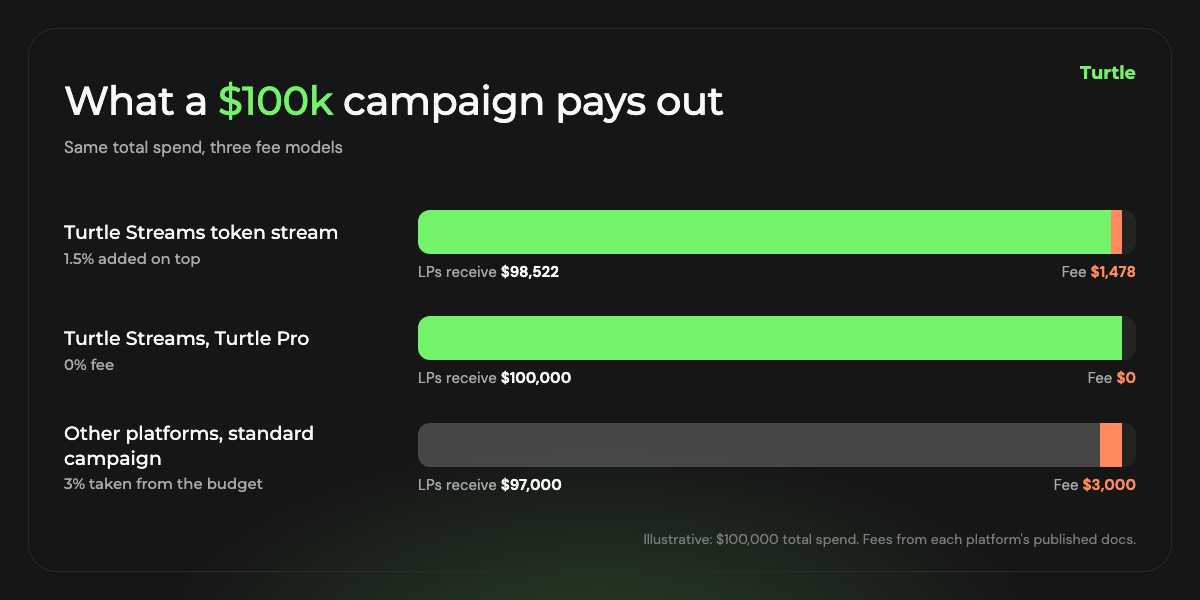
Illustrative $100k total spend under three fee models.
How does the fee change your cost per $1k of TVL?
Cost per $1k of TVL per day is what you pay each day for every $1,000 of liquidity in your pool. It is the cleanest way to compare incentive spend, because it holds across pool sizes. Our cost-per-TVL benchmarks explain the metric in depth.
Take an illustrative campaign that pays LPs $0.20 per $1k of TVL per day on a pool with $10M of TVL. The pool holds 10,000 blocks of $1k, so rewards cost $2,000 a day, and each LP earns 7.3% a year ($0.20 x 365 = $73 per $1k). These rates are illustrative; Turtle does not set a target or promise a return.
LPs earn the same $0.20 under every fee model. The fee changes what you pay per $1k and how long a $100k budget lasts:
| Fee model | LPs earn per $1k per day | You pay per $1k per day, fee included | Days a $100k budget lasts |
|---|---|---|---|
| Fee on top (Turtle Streams, 1.5%) | $0.20 | $0.203 ($0.20 + 1.5%) | 49.3 ($100k / $2,030 a day) |
| Fee from budget (other platforms, 3%) | $0.20 | $0.206 ($0.20 / 0.97) | 48.5 ($97k left for rewards / $2,000 a day) |
| No fee (Turtle Pro or points) | $0.20 | $0.20 | 50 ($100k / $2,000 a day) |
The fee either raises your cost per $1k or ends the campaign sooner. On the same $100k, a Turtle stream at 1.5% runs almost a day longer than a campaign with 3% taken from the budget, and a Turtle Pro stream runs the full 50 days.
In Streams, the Fixed Rate mechanic is set in this unit: a fixed amount of reward tokens per $1k of TVL per day. The Client Portal shows each live stream's cost per $1k of TVL per day on the Streams overview, so you can track the all-in figure as TVL moves.
Are points programs free to run?
On Turtle Streams, yes. Points streams need no funding and no onchain transaction, so they are created instantly, and Turtle's pricing page confirms they carry no creation fee.
The cost of a points program moves to the token generation event (TGE). If you convert points to tokens with a funded token stream on Turtle, the 1.5% creation fee applies to that stream like any other funded token stream, unless your organization is on Turtle Pro.
What else should you budget for beyond the platform fee?
The percentage fee is the largest line. Check these other costs before you compare quotes:
- Service tiers. Some platforms price support and managed campaigns separately from the distribution fee (see above). Streams is self-serve from the Client Portal or the API, with no subscription listed in the Streams docs.
- Organization setup. Streams requires an approved organization in the Client Portal, a master services agreement and the streams-create permission before your first stream (before you start).
- Minimum spend. A stream must distribute at least $33.33 a day, which caps its duration at your budget divided by that floor.
- Claim gas. LPs pay nothing to Turtle, but claiming is an onchain transaction. If you choose delegated claiming, you cover the gas for your users.
- Unclaimed rewards. In Streams, tokens LPs never claim can be recovered by an authorized role after the stream ends (managing a stream). On other platforms, check who can recover unclaimed rewards and when: one reserves the right to reclaim them a year after the campaign ends.
- Locked budgets. A stream is fully funded at creation, and its total and duration cannot be increased afterward. Size the budget for the whole run.
Turtle also runs Liquidity Campaigns, a separate product priced on a different model: a fee on Turtle Network TVL over time, with the rate set per campaign in the commercial agreement (pricing). This page covers self-serve campaigns only.
Which fee model fits your campaign?
Start from the number you are held to. If finance approved a fixed outlay, a fee taken from the budget keeps the outlay exact but delivers less. If you promised LPs a rate or a total, a fee on top keeps that promise and you fund the difference.
Then ask three questions of any platform:
- What is the fee rate at my total spend, including tiers already reached?
- Is it taken from the budget or added on top, for this campaign type?
- What do support, claims and leftover rewards cost?
For a step-by-step setup, read how to launch a liquidity incentive campaign.
FAQ
What is a DeFi incentive platform?
A DeFi incentive platform lets a protocol pay tokens or points to the wallets that supply liquidity to its pools or vaults. It tracks each wallet's balance, computes rewards and lets LPs claim, so the protocol does not have to build its own distribution contracts. Turtle Streams is one example.
What fees do incentive platforms charge?
Self-serve platforms charge a percentage of the rewards distributed. Turtle Streams charges 1.5% on funded token streams and nothing on points streams or for Turtle Pro organizations. Other platforms charge up to 3% on standard campaigns, falling to 1.5% at high volume, and 0.5% on airdrops. Some add monthly service tiers.
Is the fee taken from the reward budget?
It depends on the platform. Turtle Streams adds its 1.5% creation fee on top, so the full budget reaches LPs. Platforms that deduct the fee from the budget at campaign start pay out 97 tokens on a 100-token campaign at 3%.
Are points programs free?
On Turtle Streams, points streams have no funding requirement and no creation fee. Plan for the conversion at TGE: if points become tokens through a funded token stream, that stream carries the usual creation fee.
Do LPs pay a fee to claim rewards?
Turtle's pricing page states that LPs pay nothing to Turtle. Claiming is an onchain transaction, so the LP pays network gas unless the protocol uses delegated claiming, in which case the protocol's service claims for users and covers the gas.
Can the platform fee be lowered?
On tiered platforms, the rate falls as your cumulative distributions grow, and some offer a discount for committing upfront. On Turtle Streams, Turtle Pro organizations pay no creation fee.