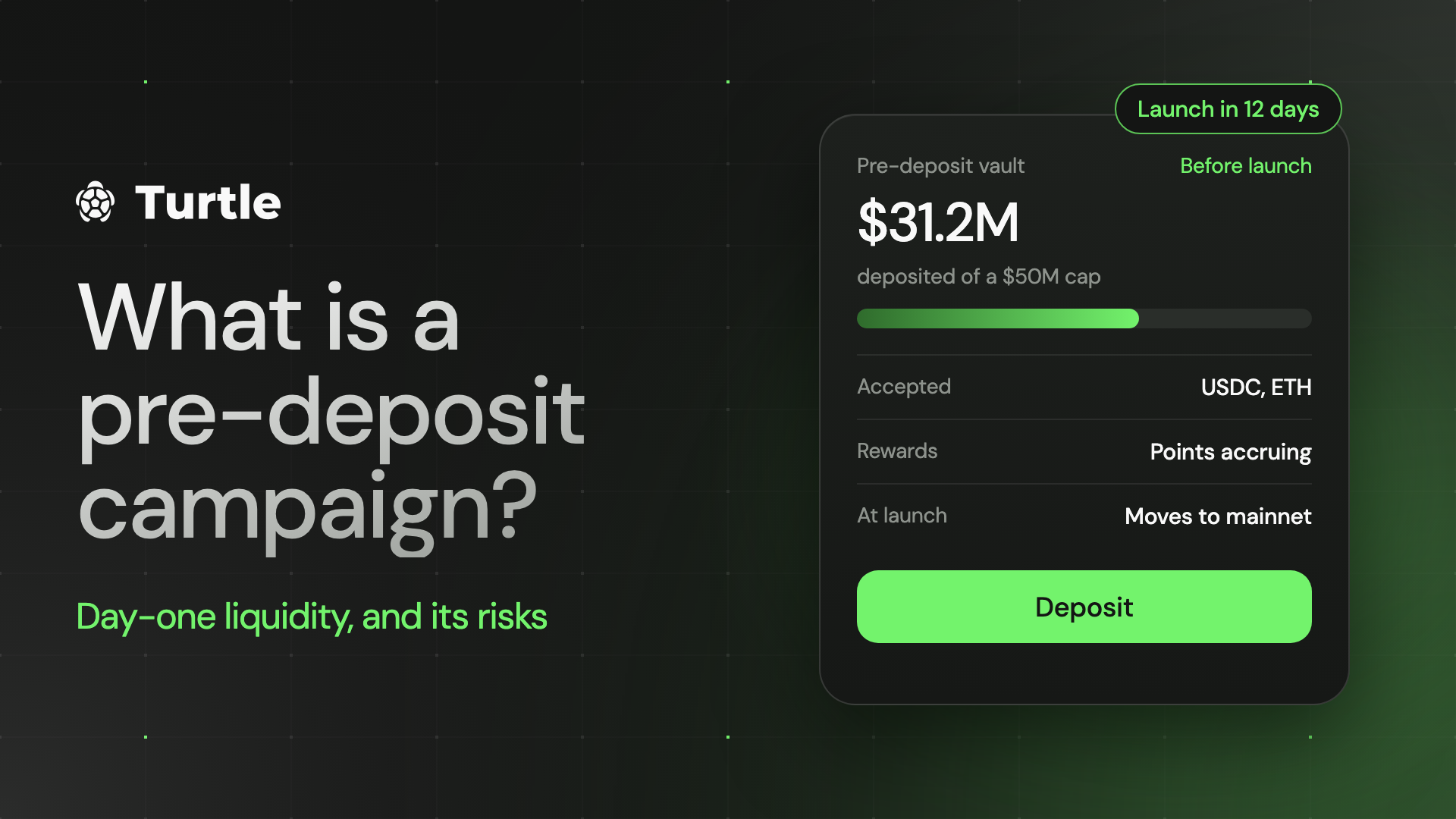

A pre-deposit campaign is a program that collects user deposits before a new blockchain, protocol or vault goes live, so it launches with liquidity on day one. Depositors put assets into a smart contract or vault ahead of launch and usually earn points, tokens or yield in return. When the product launches, the deposits move to the new chain or strategy, or depositors receive a new token that represents them.
Concrete, a vault provider, describes pre-deposit vaults as "time-limited opportunities" that let users "provide initial funding for a new chain or tokenized strategy" (Concrete docs). People also write it as "predeposit" or "pre deposit". This guide covers how a pre-deposit works, why protocols run one, what depositors get, the risks to check and real examples from project documentation.
How does a pre-deposit campaign work?
Each campaign sets its own rules, and most follow the same arc.
- The project announces the terms. It publishes which assets it accepts, the deposit window, any cap on total deposits, the rewards and what happens at launch.
- Users deposit into a contract or vault. The deposit contract holds the assets. In some campaigns, a vault curator deploys them into a strategy so they earn yield.
- Rewards accrue. Depositors earn points, a share of a token allocation or yield, often weighted by deposit size and by how long the funds stay in.
- The product launches. The chain, protocol or vault goes live with the pre-deposited liquidity already in place.
- Deposits migrate. Assets are bridged or moved to the new chain or strategy, or depositors redeem them there. Some campaigns ask depositors to stay for a set period after launch to earn the full reward.
- Rewards are paid. Points convert or tokens are released on the schedule the project published.

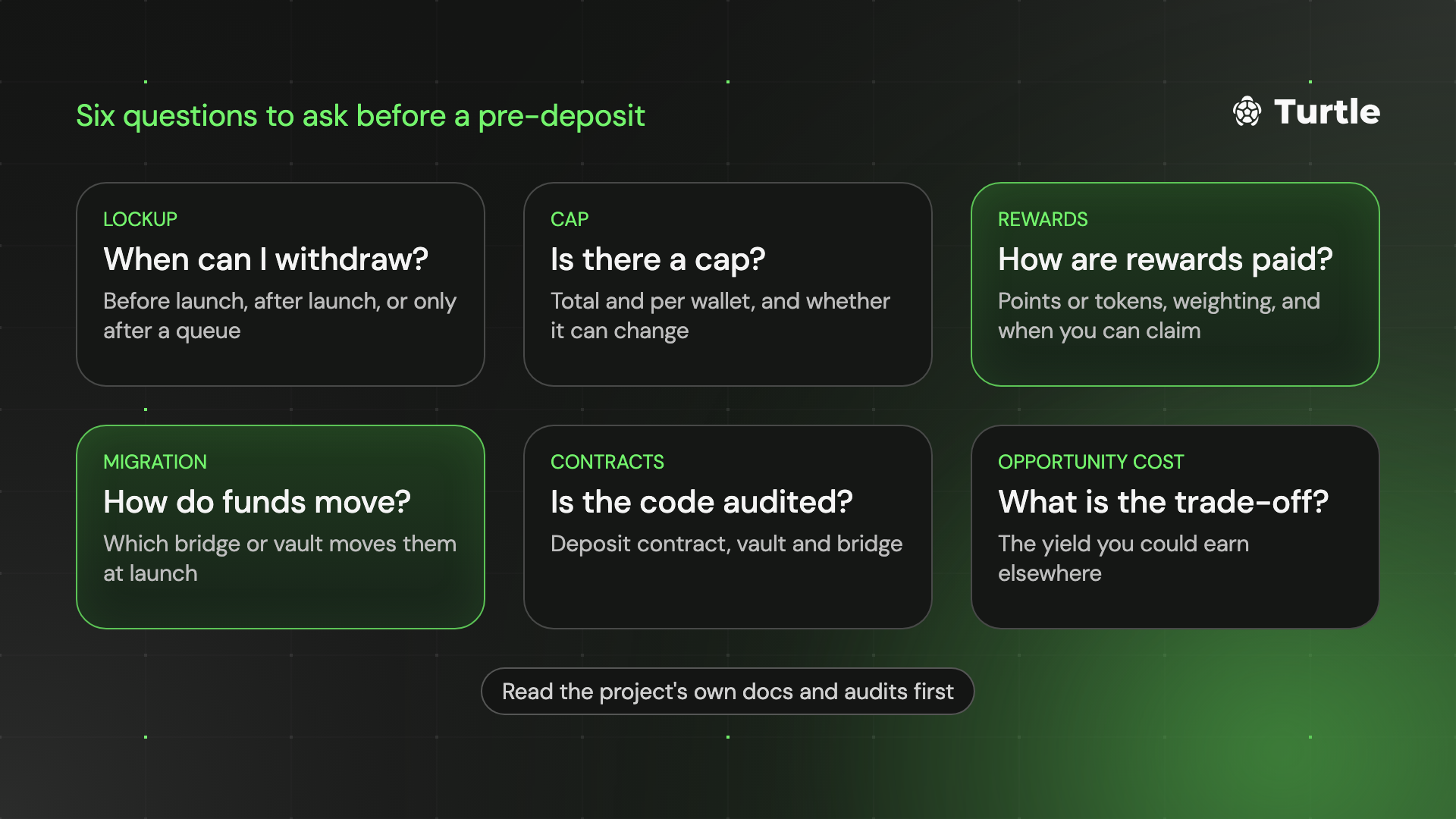 A pre-deposit fills the gap between announcement and launch, so the product opens with liquidity in place.
What terms does a pre-deposit usually set?
Before you deposit, read the terms the campaign publishes. These are the ones that change the outcome most.
| Term | What it means | What to check |
|---|---|---|
| Accepted assets | The tokens the contract takes, such as ETH, USDC or wrapped BTC | Whether your asset is bridged or wrapped first |
| Deposit cap | A limit on total deposits, sometimes per wallet | Whether the cap can change and how fast it fills |
| Lockup or withdrawal window | When you can take funds out | Withdrawal before launch, and any queue after |
| Rewards | Points, tokens, yield or a share of an allocation | How rewards are weighted and when you can claim or transfer them |
| Migration | How deposits reach the live product | Which bridge or vault moves them, and who controls it |
| Duration | Start and end of the deposit window | Whether a post-launch holding period applies |
Why do protocols run pre-deposit campaigns?
A new chain or protocol faces a cold start. Traders need deep pools before they trade, lenders need borrowers and vaults need capital, and none of them want to go first. A pre-deposit fills the pools before the doors open, so early users find working markets.
Day-one liquidity also shows up as total value locked, a number users, partners and analysts watch. Turtle's guide to what TVL is and how it is calculated explains how that figure is built.
A pre-deposit also hands the project a list of committed early users, which it can reward through its token allocation. Katana, for example, earmarked 70 million KAT for users who pre-deposited (Katana blog).
The risk for the protocol is capital that arrives for the rewards and leaves when they slow down, a pattern known as mercenary capital. Campaigns that reward time in the pool, or that ask depositors to stay after launch, try to keep that liquidity in place.
What do depositors get from a pre-deposit?
Depositors usually get one or more of these:
- Points or token allocations. Many campaigns pay points that convert into the project's token later, or a share of a fixed token allocation.
- Yield. Some campaigns deploy deposits into yield strategies. Katana, for example, put pre-deposited assets into vaults on its network at mainnet.
- An early position. Pre-depositors are often first in line for the new chain's pools and vaults.
Reward value is uncertain. A point has no market price until it converts, and a token can trade far below what depositors expected. Treat any advertised return as an estimate, and read how the project calculates it.
What are the risks of a pre-deposit?
A pre-deposit carries the usual DeFi risks plus a few that come from timing.
- Lockup risk. Some campaigns block withdrawals until launch, and a launch can slip. Your funds stay committed for longer than planned.
- Smart contract risk. The deposit contract, the vault and any bridge are code. A bug or exploit can cause losses, and audits reduce this risk without removing it.
- Migration risk. Moving deposits to a new chain means a bridge or a vault operator handles them at launch. Check who controls that step and what happens if it fails.
- Reward risk. Rewards can change, end early or arrive as tokens that cannot be transferred for months. Decibel's rewards docs, for example, state that it can "modify, suspend, or cancel any Rewards Program" (Decibel docs).
- Opportunity cost. Capital in a pre-deposit cannot be used elsewhere. If the rewards end up small, you could have earned more in another position.
- Asset risk. The asset you deposit can lose value or, for a stablecoin, lose its peg.
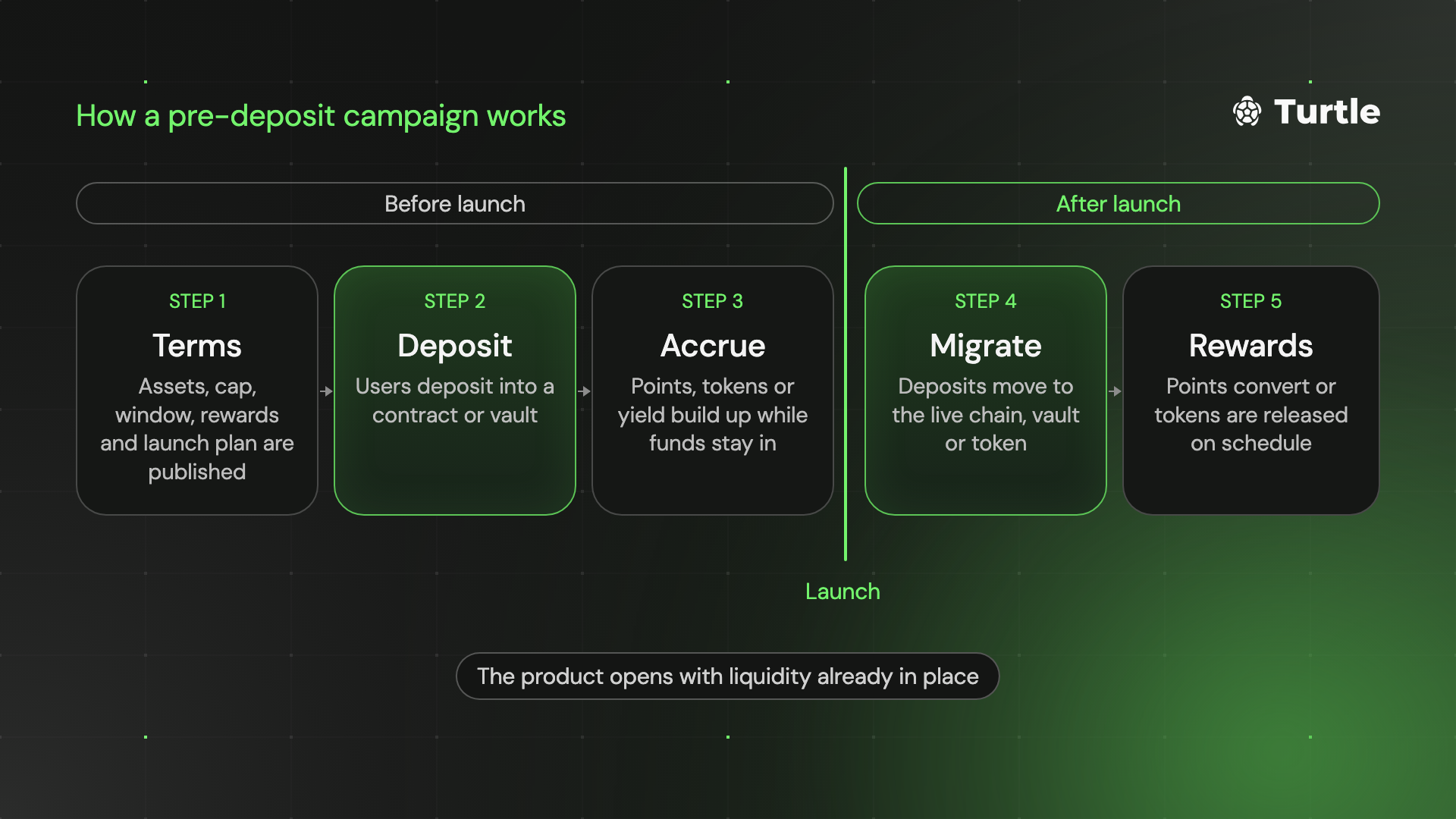 Six questions to answer before you commit funds to a pre-deposit.
No pre-deposit is risk-free. Size each deposit to what you can afford to lose, and read the project's documentation and audits first.
What are some real examples of pre-deposit campaigns?
Katana. Katana, a Layer 2 network, ran a pre-deposit campaign before its mainnet. At launch it reported "over $240 million in pre-deposits in just a few weeks". Pre-deposited assets were deployed into Yearn v3 vaults on Katana, earning yield plus KAT incentives, with no lock-up period. Katana said all KAT earned during the pre-deposit or liquidity mining phases would start out non-transferable, and that past depositors in Turtle Club, Lombard and ether.fi had to stay deposited for three months after mainnet to earn the full KAT APR (Katana blog).
Decibel. Decibel, an onchain trading platform, launched its pre-deposit vaults on February 10. Turtle LPs deployed $10M into the vaults within the first 24 hours, and Decibel closed its first day with over $40M in TVL (Turtle case study). Decibel's API documents a "Season 0 predeposit USDC reward" for each account (Decibel docs).
Berachain. Before Berachain's mainnet, vault providers ran pre-deposit vaults tied to Boyco, Berachain's pre-launch liquidity program. ether.fi's Bera ETH vault "provided ETH yield plus Berachain rewards through Boyco pre-launch and post-launch programs", with assets bridged from Ethereum to Berachain. The vault is now deprecated (ether.fi docs).
How does Turtle run pre-deposit and liquidity campaigns?
Turtle is a distribution protocol for DeFi yield. It connects protocols that need liquidity with liquidity providers and with the wallets, exchanges and apps that bring users to yield opportunities (Turtle docs). Turtle's liquidity toolkit lets protocols set deposit terms, caps and incentives for a campaign (Turtle).
For protocols, Turtle offers two ways to pay LPs:
- Liquidity Campaigns. Turtle and the protocol set the emission token, reward rate, duration and eligible vaults. Turtle sources liquidity from its member network, tracks each wallet's contribution to the campaign's TVL and pays rewards in proportion to it. Every Liquidity Campaign goes through the Turtle Due Diligence Council before it goes live (Turtle docs).
- Streams. A self-serve campaign the protocol runs itself. A deposit-based stream rewards how long depositors commit, with tiered rates that become claimable at cliffs, and withdrawing before a cliff forfeits that tier's unvested rewards (Turtle docs). That structure fits a launch that wants depositors to stay.
For Decibel's pre-deposit, Turtle's team ran due diligence on the protocol, defined terms and risk parameters with the Decibel team, and gave LPs onboarding and bridging support ahead of launch (Turtle case study).
For LPs, Turtle is non-custodial: you sign every transaction from your own wallet, and Turtle cannot move, hold or freeze your funds (Turtle docs). LPs pay nothing to Turtle (Turtle docs). You can browse current Turtle Deals at app.turtle.xyz/earn.
For the design side of a launch campaign, see Turtle's guide on how to design a liquidity mining campaign that retains capital.
If you are launching a chain, protocol or vault and want liquidity in place on day one, see how Turtle runs liquidity campaigns at turtle.xyz/liquidity.
FAQ
What does predeposit mean in crypto?
A predeposit, or pre-deposit, is a deposit made into a smart contract or vault before the product it funds goes live. The deposit gives the new chain, protocol or vault liquidity at launch, and the depositor usually earns points, tokens or yield.
Can you withdraw a pre-deposit before launch?
It depends on the campaign. Some block withdrawals until launch, some allow them at any time and some reduce rewards for early exits. Check the withdrawal terms before you deposit.
Are pre-deposit rewards guaranteed?
No. Points and token allocations depend on the project's rules, which can change, and the tokens can be non-transferable for a period or trade below expectations. Treat advertised rewards as estimates.
What is the difference between a pre-deposit and a presale?
A presale sells a new token to buyers before it lists. A pre-deposit keeps your assets as a deposit that you can withdraw under the campaign's terms, and the project pays rewards for the liquidity you provide.
What happens to a pre-deposit at launch?
The deposits move to the live product. Depending on the campaign, they are bridged to the new chain, deployed into vaults there or redeemed for a new token. Katana, for example, deployed pre-deposited assets into Yearn v3 vaults on its network at mainnet.
How do protocols attract pre-depositors?
Protocols publish rewards such as points or token allocations, partner with vault curators and distribution platforms, and reach out to LPs with a record of holding positions. Turtle connects protocols with a network of LPs and measures the TVL each campaign brings in.