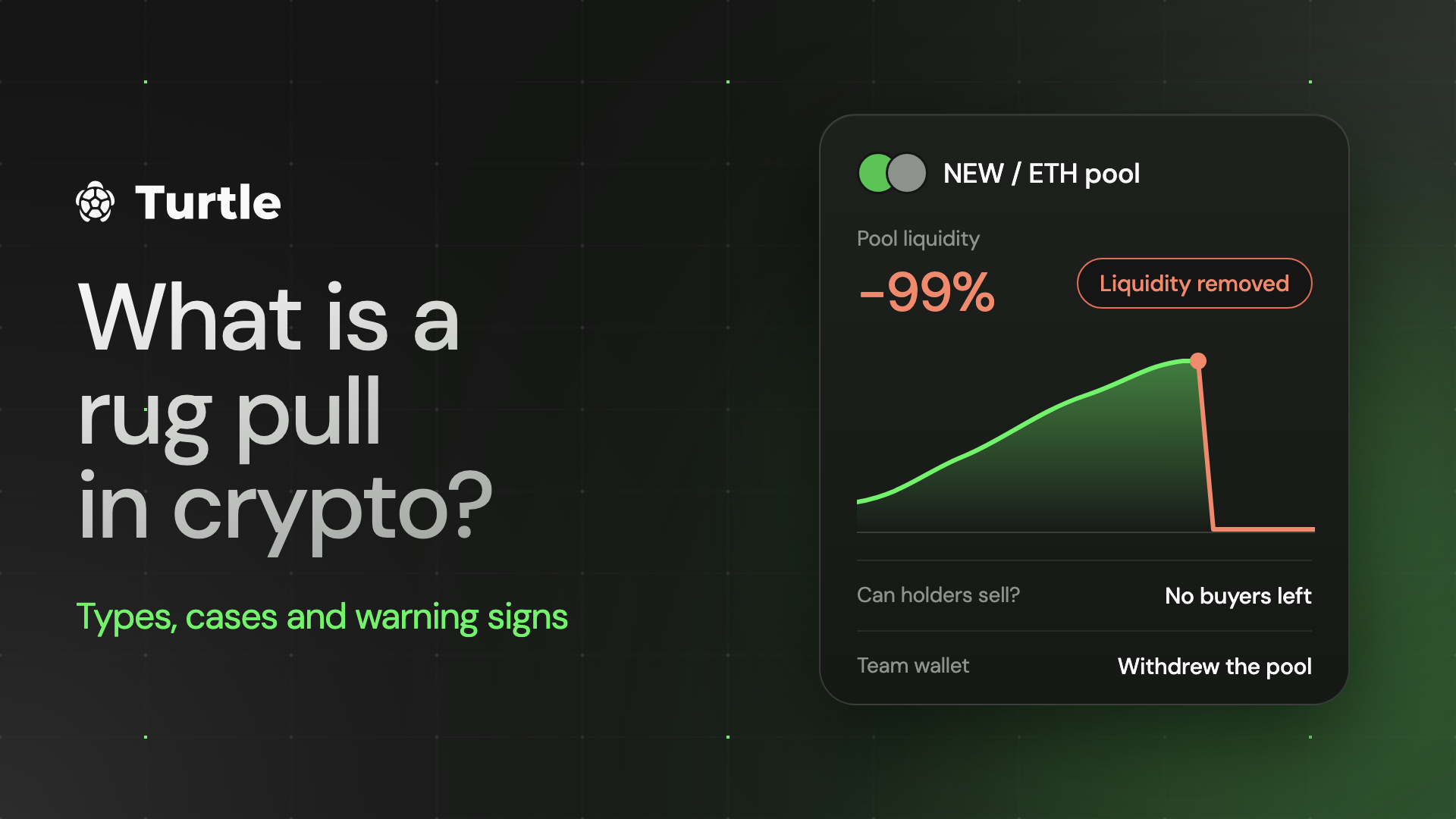

A rug pull is a crypto scam in which the people behind a project attract buyers or depositors, then take the money and disappear. Most often, the team drains the liquidity pool that backs its token or sells its own large holdings, and the token's price falls close to zero. Chainalysis describes it as developers who "drain the funds from the liquidity pool, sending the token's value to zero, and disappear" (Chainalysis).
The name comes from the phrase "pulling the rug out from under someone". This guide explains how a rug pull works, the main types, well-documented cases, the warning signs and the habits that reduce your exposure.
How does a rug pull work?
Most rug pulls follow the same pattern on a decentralized exchange (DEX):
- A team launches a token. Creating a token and listing it on a DEX is cheap and needs no approval. Chainalysis notes that projects can list "without a code audit".
- It creates a liquidity pool. The team pairs its new token with a valuable asset such as ETH or a stablecoin, so people can buy it.
- It builds hype. Social media posts, influencer mentions and promises of high returns pull in buyers. Each purchase adds valuable assets to the pool.
- Insiders cash out. The team withdraws the valuable assets from the pool, sells its own tokens into the buyers' demand, or both.
- The project goes dark. The website, Discord and social accounts vanish, and buyers are left holding a token nobody will buy.

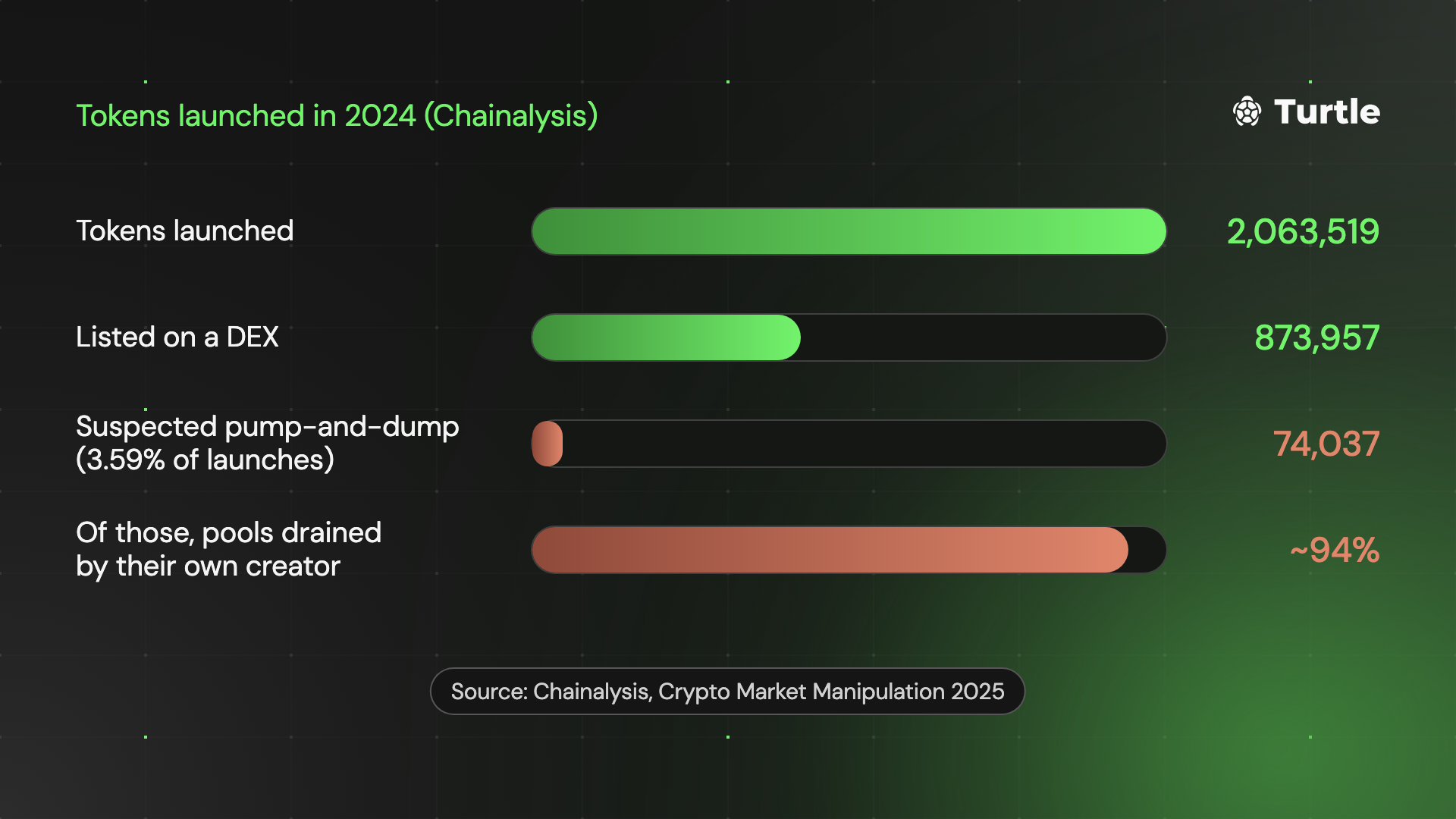 Buyers fill the pool, then insiders take what is in it.
Blockchain transactions are final, so once the funds leave the pool, there is usually no one to reverse them.
What are the main types of rug pulls?
Rug pulls come in four common forms. Some projects combine more than one.
| Type | What happens | Documented example |
|---|---|---|
| Liquidity pull | Insiders withdraw the valuable assets from the token's liquidity pool | AnubisDAO, October 2021 |
| Malicious code (honeypot) | The token's contract lets people buy and blocks them from selling | Squid Game token, November 2021 (buyers could not sell) |
| Soft rug (dumping) | Insiders hold a large share of the supply and sell it into the hype | Pattern tracked across thousands of 2024 tokens by Chainalysis |
| Exit scam | A team or company stops withdrawals or deliveries and leaves with users' money | Thodex exchange, 2021; Frosties NFTs, 2022 |
Liquidity pull. This is the classic "hard" rug pull. Halborn explains that once the pool "has gained enough value, the fraudsters will 'pull the rug'" by draining it (Halborn).
Malicious code. CertiK describes honeypot contracts as tokens that users can buy and then cannot sell, which makes them worthless to the buyer. Common tricks include a blacklist that blocks every buyer from selling and a minimum sell amount set higher than anyone can reach (CertiK).
Soft rug. A team keeps the code clean and simply sells. Chainalysis describes the pattern: an insider holds a large share of a token, hypes it, sells once the price peaks, and leaves other holders "holding the bag" (Chainalysis).
Exit scam. The broader term for any operator who collects money and vanishes. In crypto it covers centralized platforms that freeze withdrawals and NFT teams that abandon a project after the mint.
What are some well-known rug pulls?
Squid Game token (2021)
A token named after the Netflix series surged by thousands of percent in a few days and then lost almost all of its value. The BBC reported on 2 November 2021 that "people who bought Squid tokens were unable to sell them", that the website and social accounts had vanished, and that the developers made off with an estimated $3.38 million, a figure from Gizmodo (BBC).
AnubisDAO (2021)
AnubisDAO launched on October 28, 2021, with no website, no white paper and pseudonymous developers. It raised nearly $60 million from investors practically overnight. Around 20 hours after the sale began, the address that created the pool, which held most of its LP tokens, withdrew nearly all the wrapped ETH. Chainalysis counted over $58 million taken and called it the second-largest rug pull of 2021 (Chainalysis).
Thodex (2021)
Centralized platforms can rug their users too. Thodex, a Turkish centralized exchange, halted withdrawals and its CEO disappeared. Chainalysis counted over $2 billion in user losses, nearly 90% of all value taken in rug pulls that year (same source).
Frosties NFTs (2022)
The Frosties team sold out 8,888 NFTs in January 2022, took in about $1.1 million in ETH, closed the project's Discord and disappeared. In March 2022, the US Department of Justice charged two people over the scheme with conspiracy to commit wire fraud and conspiracy to commit money laundering (Decrypt).
How common are rug pulls?
Chainalysis estimated that rug pulls took more than $2.8 billion from victims in 2021, or 37% of all crypto scam revenue that year, up from 1% in 2020 (Chainalysis).
Its 2025 market manipulation study looked at the tokens launched in 2024. Of about 2.06 million new tokens, 873,957 were listed on a DEX, and 74,037 (3.59% of all launches) showed patterns linked to pump-and-dump schemes. In about 94% of those cases, the pool appears to have been drained by the address that created it (Chainalysis).
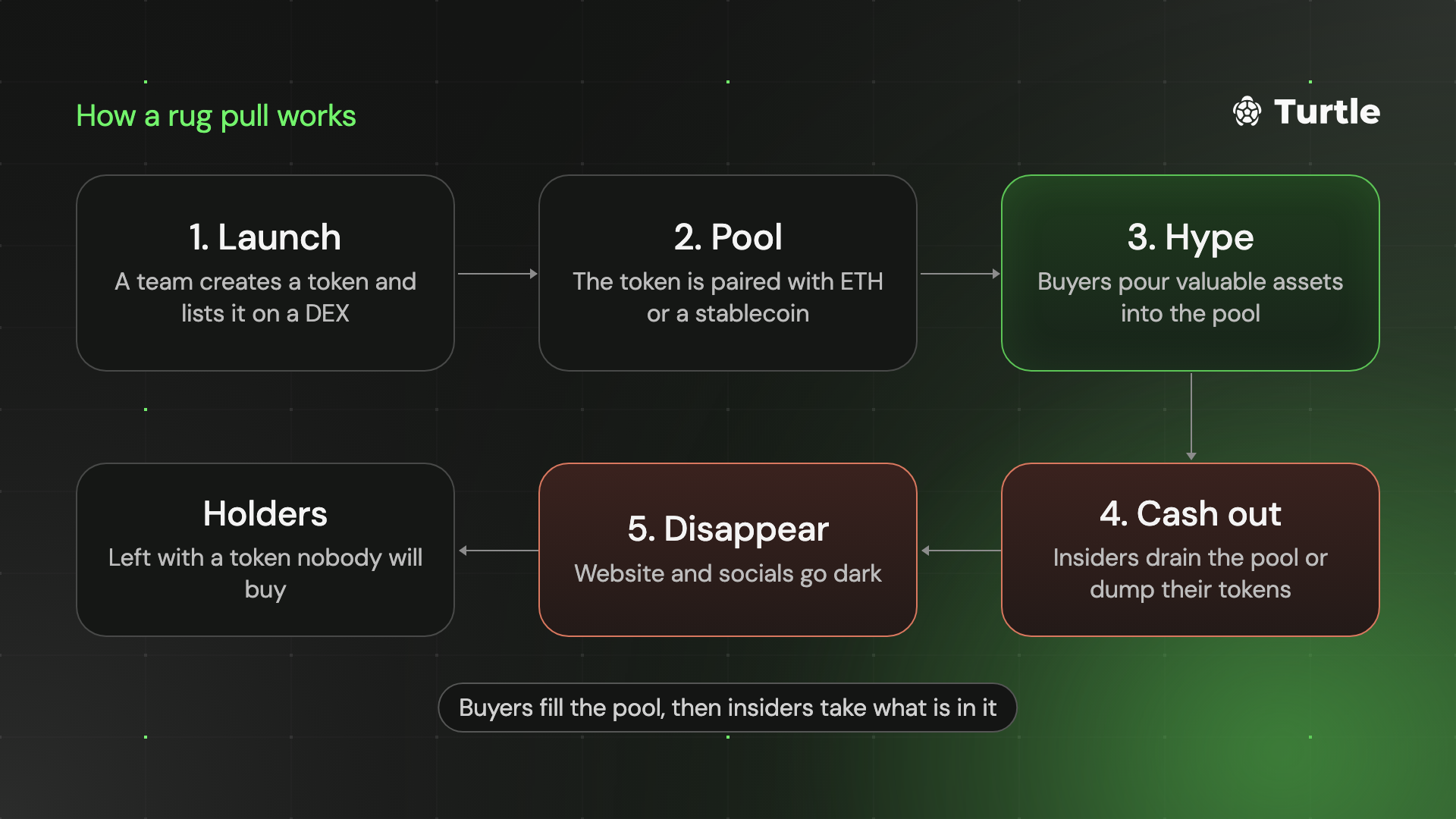 Most suspected pump-and-dump pools were drained by their own creator. Source: Chainalysis, 2025.
The tokens with these patterns were short-lived. Chainalysis found the average one lasted about six days.
What are the warning signs of a rug pull?
No single sign proves a scam, and a project can show none of them and still fail. These are the patterns that show up again and again in documented cases:
- Anonymous team with no track record. AnubisDAO had pseudonymous developers and no website or white paper. Halborn lists a fully anonymous team as a red flag.
- Liquidity controlled by the team. If the deployer holds most of the pool's LP tokens and nothing locks them, the team can withdraw the pool at any time, as happened with AnubisDAO.
- Concentrated token supply. A few wallets holding a large share of the supply can sell into any rally. Turtle's guide to what tokenomics is explains how to read supply and allocation.
- No audit. Chainalysis points to the absence of a code audit as a common thread in DeFi rug pulls.
- Few or no sells on the chart. CertiK notes that an all-green chart with a very small sell count is a good indication of a honeypot.
- Returns that look too good to be true. Halborn flags promises with no credible plan behind them.
- Sloppy materials and pressure to buy fast. Critics of the Squid Game token pointed to spelling mistakes and grammar errors on its website.
Spotting these signs in practice, with block explorers and token scanners, takes its own guide.
How can you reduce your exposure to rug pulls?
You cannot remove the risk, and you can lower it with a few habits:
- Know where the yield or the price gain comes from. A return with no clear source is a warning on its own. Turtle's guide to how crypto vaults work shows where vault yield comes from.
- Read the contract's audits and who controls it. Check whether admin keys can change the code, mint tokens or move funds.
- Check the pool and the holders. Look at who holds the LP tokens, whether the liquidity is locked, and how the supply is spread across wallets.
- Watch for exits on day one. Be extra careful with brand-new tokens, where AnubisDAO and most suspected pump-and-dump pools ran their course within days.
- Keep custody and size positions. Use your own wallet, deposit only what you can afford to lose, and spread deposits across projects.
- Prefer opportunities that someone has reviewed. An independent review checks contracts, teams and liquidity before money goes in. Reviews lower risk and leave some in place.
How does Turtle review opportunities before you deposit?
Turtle is a distribution protocol for DeFi yield. It connects yield opportunities, such as vaults, with the wallets, exchanges and other platforms that bring depositors to them (Turtle docs).
Turtle Deals, listed on the Earn page of the Turtle app, pass a review by the Turtle Due Diligence Council (TDC) before they go live. The council evaluates vaults and deals across four risk dimensions (Turtle docs):
- Technical risk: smart contract quality, audit history and upgrade mechanisms.
- Operational risk: team background, custody model and operational controls.
- Financial risk: collateralization, liquidity profile and historical performance.
- Curator risk: track record, conflicts of interest and disclosure practices.
Council members operate independently of Turtle's commercial team, and the TDC can decline a vault or deal regardless of the commercial relationship. Where a review has been completed, a written report is published with the vault listing.
The Discover page of the Turtle app indexes thousands of DeFi opportunities, and only the Turtle Deals among them carry a TDC review. For any other listing, read the vault's own docs and audits before you deposit (Turtle docs).
Turtle is also non-custodial. Turtle builds an unsigned transaction and you sign it from your own wallet, so Turtle cannot move, hold or freeze your funds. Your deposit goes into the vault contract you chose (Turtle docs). No review removes every risk, so the habits above still apply.
Browse reviewed Turtle Deals at app.turtle.xyz/earn.
FAQ
What does "rug pulled" mean?
Being rug pulled means a project you bought into or deposited in was abandoned by its team, which took the funds with it. The term comes from "pulling the rug out from under someone".
Is a rug pull illegal?
Rug pulls built on false promises can lead to fraud charges. In the Frosties case, US prosecutors charged two people with conspiracy to commit wire fraud and conspiracy to commit money laundering. Pseudonymous teams can be hard to identify, which makes it difficult to hold them responsible.
What is a soft rug pull?
A soft rug pull is when insiders slowly or suddenly sell a large share of a token's supply, leaving the code and pool in place. The price collapses even though no funds were drained from a contract.
What is a honeypot in crypto?
A honeypot is a token whose smart contract lets people buy and blocks them from selling. Buyers see a rising chart, and their tokens are trapped once they buy.
What is the difference between a rug pull and a hack?
In a rug pull, the project's own team takes the money. In a hack, an outside attacker exploits a flaw in the code or steals keys. The line can blur: after the AnubisDAO drain, one founder claimed a phishing attack, and Chainalysis found the evidence did not support that account.
Does an audit prevent a rug pull?
An audit lowers the risk of hidden malicious code, such as sell blocks or unlimited minting. It cannot stop a team from selling tokens it legitimately holds or from withdrawing liquidity it controls.