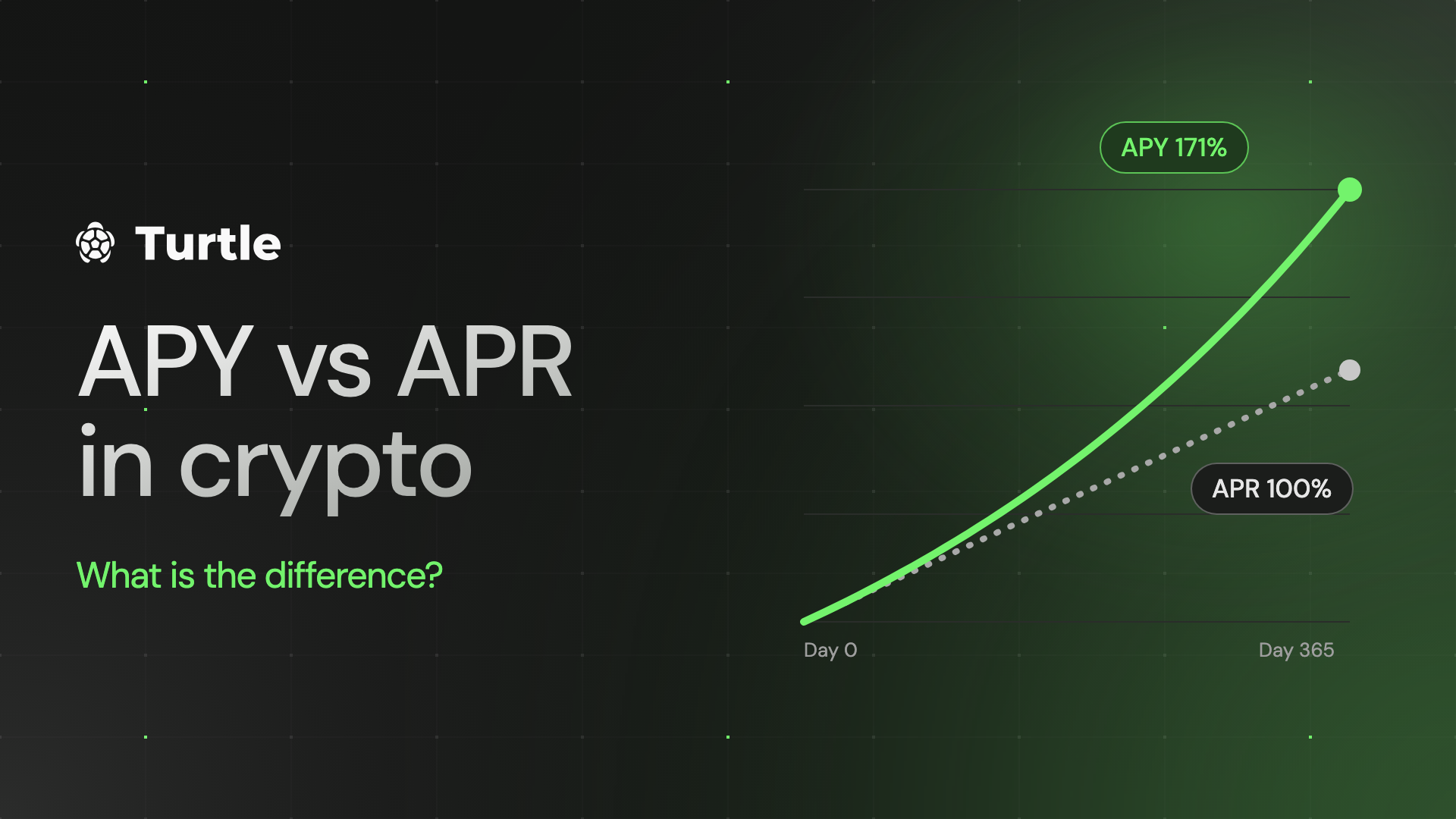

APR (annual percentage rate) is the simple yearly rate, with no compounding. APY (annual percentage yield) includes compounding, so it assumes the interest or rewards you earn are added back and start earning too. For the same underlying rate, APY is always equal to or higher than APR, and the gap grows as the rate rises and as compounding happens more often.
In banking, APR usually describes the cost of a loan and APY the return on savings. In crypto, both describe what you earn on staking, lending, liquidity pools and vaults. This guide shows the math with illustrative numbers, why crypto apps show one or the other, why the rate on screen moves and how to compare two opportunities fairly.
What does APR mean in crypto?
APR is the rate you earn over a year on your original deposit, with nothing reinvested. A 10% APR on 10,000 USDC pays 1,000 USDC over a year, if the rate stays at 10% the whole time.
Crypto apps use APR for:
- Lending: the rate suppliers earn and borrowers pay in a money market.
- Staking: the reward rate a network or a staking service pays on staked tokens.
- Liquidity pools: trading fees paid to liquidity providers, expressed as a yearly rate.
- Incentives: extra tokens a protocol pays depositors, quoted as a yearly rate on the deposit's value.

In traditional finance, APR on a loan can also include fees (Wikipedia). In DeFi, the APR shown on a yield page usually describes the rate alone, and fees are listed separately.
What does APY mean in crypto?
APY is the rate you would earn over a year if every payout were reinvested at the same rate. It is "a normalized representation of an interest rate, based on a compounding period of one year" (Wikipedia). Because it folds in compounding, APY lets you compare rates that pay out on different schedules.
Compounding is interest earned on interest. The SEC's Investor.gov uses a simple example: $100 earning 5% a year becomes $105 after one year and $110.25 after two, because the second year also pays 5% on the first year's $5 (Investor.gov).
In crypto, compounding happens in two ways. Some positions compound by themselves: a vault share or a liquid staking token rises in value as yield accrues. Others pay rewards that you claim and redeposit by hand, and those only compound if you actually do it.
How do you convert APR to APY?
The standard formula is (Wikipedia):
APY = (1 + APR / n)^n - 1
Here n is the number of compounding periods in a year: 1 for yearly, 12 for monthly, 365 for daily.
Here is an illustrative example with a 10% APR on a 10,000 USDC deposit. The rate is made up to show the math, and it holds steady for the full year.
| Compounding | APY | Earned in one year |
|---|---|---|
| None (simple APR) | 10.00% | 1,000.00 USDC |
| Monthly (n = 12) | 10.47% | 1,047.13 USDC |
| Daily (n = 365) | 10.52% | 1,051.56 USDC |
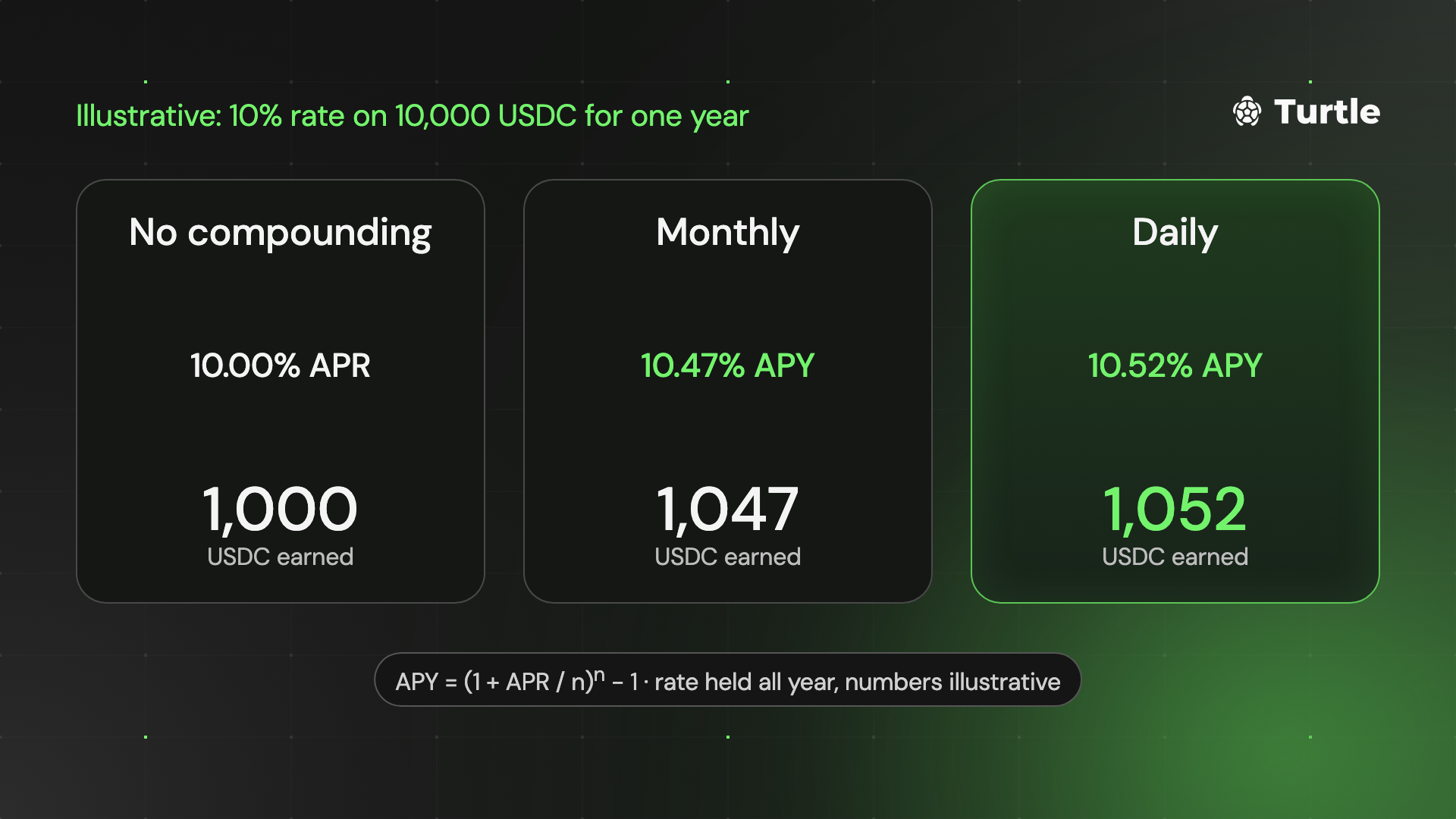
The same 10% rate, three results. Compounding more often raises the APY.
To go the other way, from APY to APR, reverse the formula: APR = n × ((1 + APY)^(1/n) - 1). An APY of 12% with daily compounding works out to an APR of about 11.33%.
How much does compounding add at higher rates?
At low rates the two numbers sit close together. At the higher rates common in crypto, the gap gets wide. Wikipedia gives the extreme case: a 100% nominal rate becomes an APY of about 171% with frequent compounding.
The table compares illustrative APRs with the APY they imply at daily compounding:
| APR | APY, compounded daily | Gap |
|---|---|---|
| 5% | 5.13% | 0.13 points |
| 10% | 10.52% | 0.52 points |
| 20% | 22.13% | 2.13 points |
| 50% | 64.82% | 14.82 points |
| 100% | 171.46% | 71.46 points |
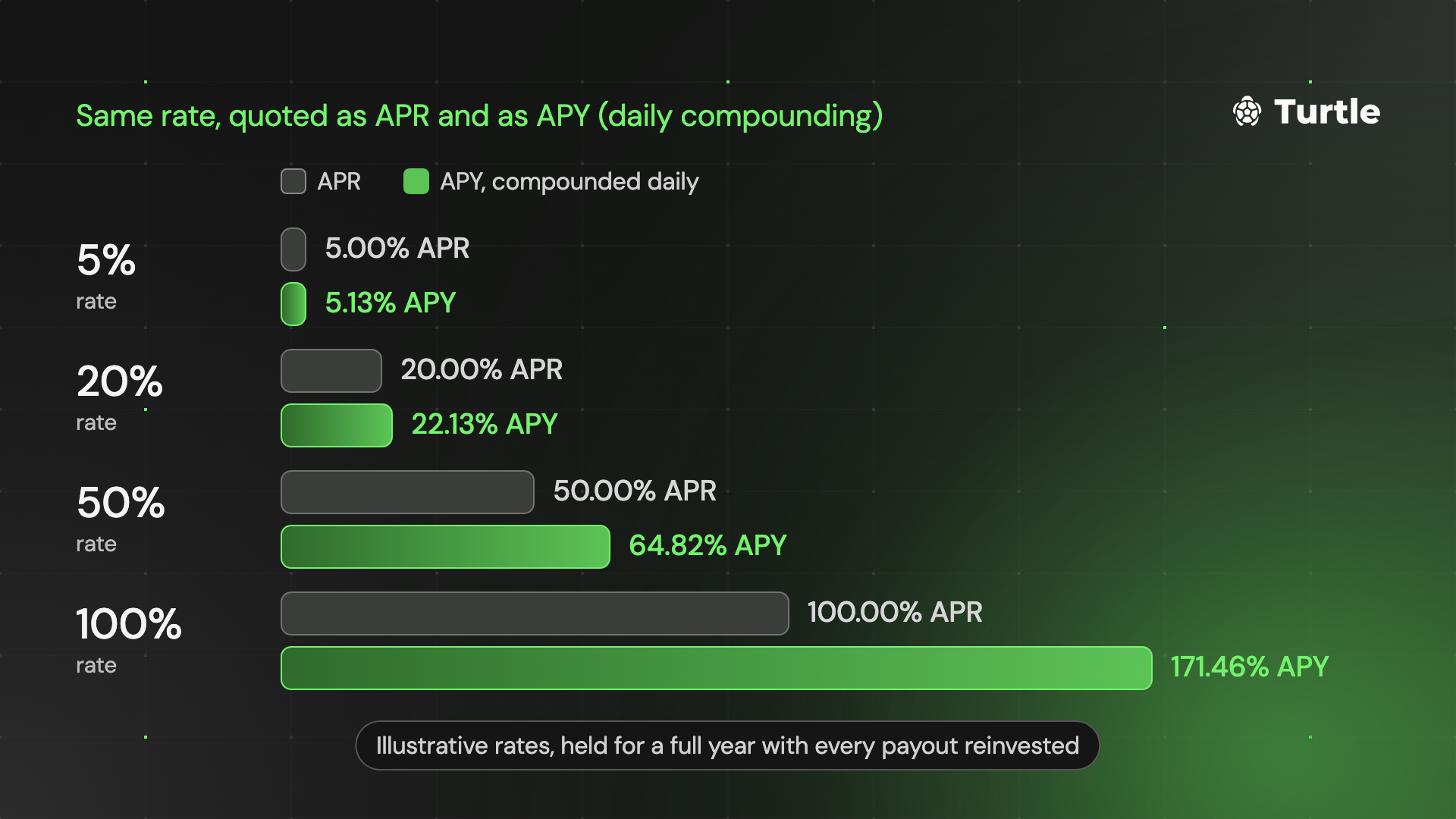
The higher the rate, the more daily compounding adds to the headline APY.
This is why a high APY deserves a second look. A large part of it can come from the compounding assumption, which only holds if the rate stays high all year and every reward is reinvested.
Why do crypto platforms show APR or APY?
Each number answers a different question. APR tells you what the position pays on your deposit. APY tells you what it could pay if everything were reinvested on schedule.
APY fits positions that compound by themselves. When a vault reinvests its yield, the value of your share grows and the compounding is already inside it. On Turtle, for example, native yield compounds in the vault (Turtle docs).
APR fits rewards that do not compound by themselves. Incentive tokens collect in your wallet or on a claim page. To compound them, you have to claim, swap them into the deposit asset and deposit again, and each step can cost gas and swap fees. If the reward token's price falls in the meantime, the reinvested amount falls too.
When two pages use different terms, convert one of them before you compare. A 10% APR and a 10.5% APY with daily compounding describe almost the same rate.
Why does the rate you see change?
Crypto yields are variable. The APR or APY on a page is an estimate built from recent data, and several things move it:
- Demand for the asset. Lending rates rise when more people borrow and fall when more people supply.
- The averaging window. Many apps compute the rate from a trailing window. A 24-hour rate reacts fast; a 30-day rate is smoother.
- TVL. When an incentive budget is fixed per day, more deposits split the same rewards, so the rate per depositor falls. More on TVL in what is TVL in crypto.
- Reward token price. An incentive rate quoted in dollars falls when the reward token's price falls.
- Incentives ending. When a campaign ends, its share of the rate goes to zero.
- Fees. Performance or management fees can come out of the yield before it reaches you.
Treat a displayed APR or APY as a snapshot of recent performance. It is an estimate and carries no promise about the next twelve months.
How does Turtle show APR and APY?
Turtle lists yield opportunities across DeFi and shows each rate split into its sources, so you can see how much comes from the vault itself and how much from rewards on top.
- Est. APR by source. The deposit panel lists each part of the rate: the vault's Native Yield plus each active stream, with estimated monthly earnings as you type an amount (Turtle docs).
- A chosen window. Tables show a 30d Est. Total APR, and a 24h / 7d / 30d toggle changes the window the rate is computed over (Turtle docs).
- Net APR. The opportunity page shows the total estimated rate, as a range when a stream pays a variable rate.
- Where rewards go. Native yield compounds in the vault. Extra rewards from streams and other incentive programs collect in Portfolio › Earnings, where you claim them (Turtle docs).
- Both series in the API. The Turtle Earn API returns APR and APY over time for a vault, each split into base, reward and total (Turtle docs).
Protocols that pay incentives through Turtle Streams also choose how the rate is set. A Fixed APR stream pays a set annual rate on top of the native rate. A Target APR stream pays only the gap between a target rate and the vault's native APY, measured over a trailing window, and pays nothing when the vault already meets the target (Turtle docs).
Turtle Deals on the Earn page pass a review by the Turtle Due Diligence Council before they go live. The rates are still estimates, and every deposit carries smart contract and strategy risk. For the full path of a deposit, see how crypto vaults work.
How do you compare two yield opportunities?
Use these questions before you choose between two rates:
- Same unit: are both quoted as APR or both as APY? Convert one if not.
- Compounding: does the position compound by itself, or do you claim and reinvest by hand?
- Sources: how much of the rate is native yield and how much is incentives?
- Reward asset: is the incentive paid in the deposit asset, another token or points?
- Window: is the rate a 24-hour figure or a 30-day average?
- Fees and costs: are fees already taken out, and what will claiming and swapping cost you?
- Risk: who runs the strategy, how withdrawals work and what could cause a loss.
A rate is one input. The source of the yield and the risks behind it matter as much as the number.
You can compare rates by source and window on the Turtle Earn page.
FAQ
Is APY better than APR?
Neither is better. They measure the same rate in two ways. APY includes compounding, so it reads higher for the same position. Compare APY with APY, or APR with APR.
Can APR and APY be the same?
Yes. When interest compounds once a year, or not at all, APR and APY are equal. They also sit very close at low rates: a 1% rate compounded often gives an APY of about 1.005%.
What is 5% APY on $1,000?
If the rate held at 5% for a full year, $1,000 would earn $50, ending at $1,050. With monthly compounding, that works out to about $4.07 in the first month. Crypto rates move, so treat this as an illustration.
How do you convert APY to APR?
Use APR = n × ((1 + APY)^(1/n) - 1), where n is the number of compounding periods per year. A 5% APY with daily compounding equals an APR of about 4.88%.
Is APY guaranteed in crypto?
No. Crypto APYs are variable estimates based on recent data. They change with demand, deposits, reward token prices and the end of incentive programs, and the underlying positions carry smart contract and market risk.
Why is APY higher than APR?
APY assumes each payout is reinvested and starts earning too. That extra interest on interest is the difference. The more often a position compounds and the higher the rate, the larger the gap.