
Tokenomics is the set of rules that decides how a crypto token is created, distributed, used and valued over time. It covers how many tokens exist, who receives them and when, what holders can do with them and what adds or removes tokens from circulation. CoinMarketCap describes it as "a set of rules that governs a cryptocurrency's launch and supply" (CoinMarketCap).
The word joins "token" and "economics", and you will also see it written as token economics. In AI, the same word now describes the cost of the tokens a language model reads and writes. This guide covers the crypto meaning: the parts of a token's design, the supply numbers to read, how unlocks and incentives change supply, and what to check before you trust a project's token model.
What does tokenomics mean in crypto?
In crypto, tokenomics is the economic design of a token. A blockchain enforces part of it in code, such as a maximum supply or a burn on every transaction. The rest lives in a project's documents and smart contracts: how the team, investors and community share the supply, how long their tokens stay locked and how the project pays users to take part.
Good tokenomics lines up those rules with the behavior a project wants. A lending protocol may want long-term depositors, a DEX may want deep pools and a network may want validators who stay online. The token is the budget and the reward for all of it, so its design shapes who joins, who stays and who sells.
What are the parts of tokenomics?
Most token models can be read through six parts.
| Part | The question it answers | Example |
|---|---|---|
| Supply | How many tokens exist, and is there a cap? | Bitcoin stays slightly under 21 million |
| Allocation | Who receives the supply at launch? | Team, investors, treasury, community, incentives |
| Vesting and unlocks | When can each group move or sell its tokens? | A one-year cliff, then monthly unlocks |
| Emissions | How are new tokens released over time? | Block rewards, staking rewards, liquidity incentives |
| Utility | What can a holder do with the token? | Pay fees, stake, vote, access a product |
| Sinks and value capture | What removes tokens or ties them to revenue? | Burns, buybacks, fee sharing |
The parts depend on each other. A large incentive allocation with short vesting means many tokens reach the market early. A strong burn can offset steady emissions. Reading one part on its own gives a partial picture.
What is the difference between max supply, total supply and circulating supply?
Three supply numbers appear on every token page, and each one means something different (CoinMarketCap):
- Maximum supply is the hard limit the token can never exceed. Some tokens have none.
- Total supply is every token created so far, minus the tokens that have been burned.
- Circulating supply is the best estimate of the tokens available to the market today. Locked team and investor tokens are left out of it.

Two valuations come from these numbers. Market cap is the circulating supply times the price. Fully diluted valuation (FDV) is the maximum supply times the price, which shows what the token would be worth at today's price once every token exists.
Here is an illustrative example. The numbers are made up to show the math.
| Metric | Value |
|---|---|
| Maximum supply | 1,000,000,000 tokens |
| Circulating supply | 250,000,000 tokens |
| Price | $0.40 |
| Market cap (circulating × price) | $100,000,000 |
| FDV (maximum × price) | $400,000,000 |
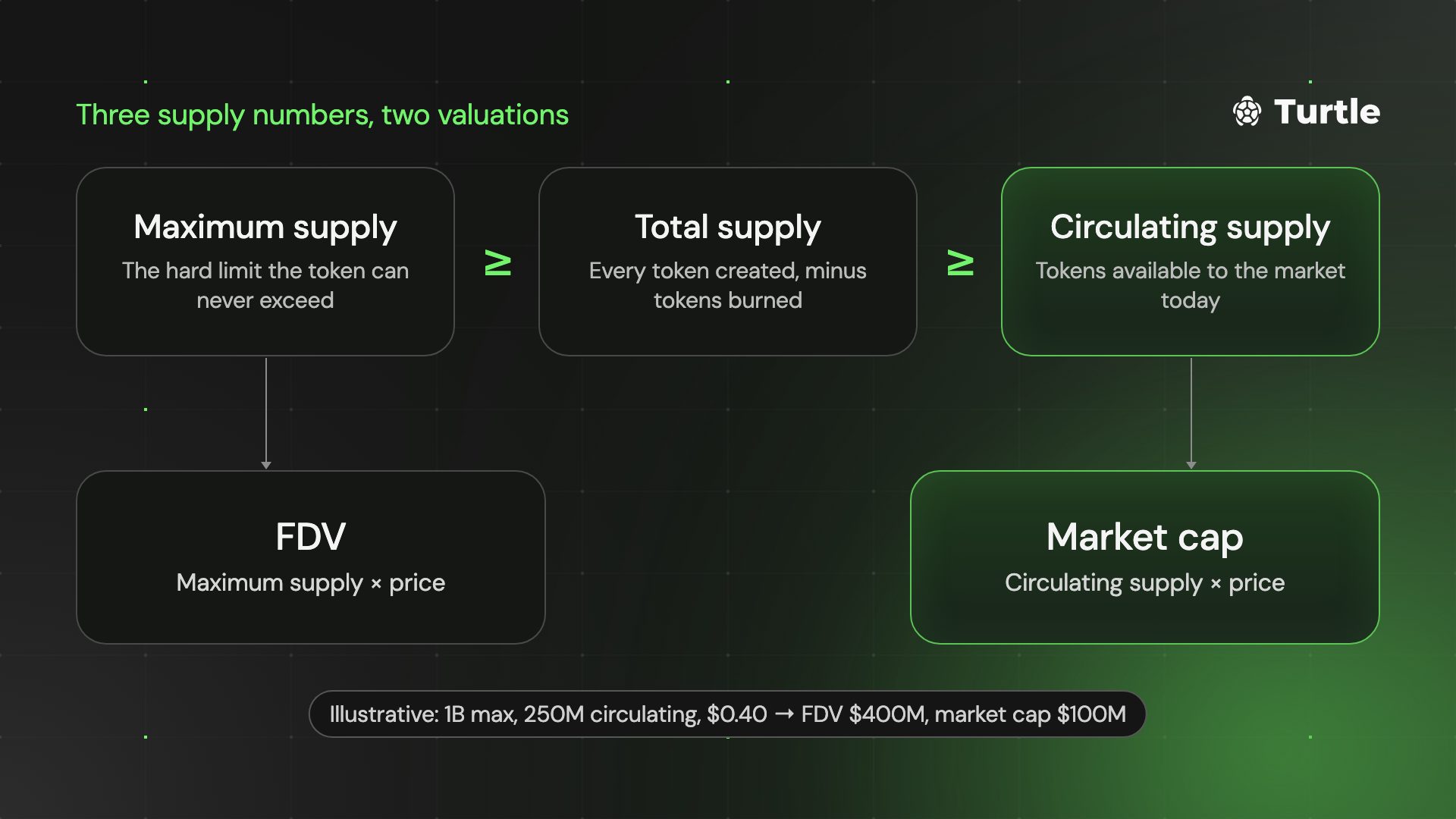
Market cap uses the circulating supply. FDV uses the maximum supply.
A wide gap between market cap and FDV means most of the supply is still to come. In the example, 75% of the tokens are not circulating yet, and every unlock or emission adds to the amount the market has to absorb.
How does a token's supply change over time?
Supply moves through two forces: new tokens enter through emissions, and tokens leave through burns.
Emissions. Many networks release new tokens on a schedule. Bitcoin pays a block reward that halves every 210,000 blocks, about every four years, so the number of bitcoins will stay slightly under 21 million (Bitcoin Wiki). DeFi protocols often emit tokens to stakers and liquidity providers, which raises supply for as long as the program runs.
Burns. A burn sends tokens to an address no one controls, which removes them for good. On Ethereum, the base fee of every transaction is burned, so the ETH supply depends on how much is issued to validators and how much is burned by network activity (ethereum.org).
A token is called inflationary when emissions outpace burns and deflationary when burns outpace emissions. Neither label is good or bad by itself. What matters is whether the new supply pays for something the protocol needs.
What are token allocation and vesting?
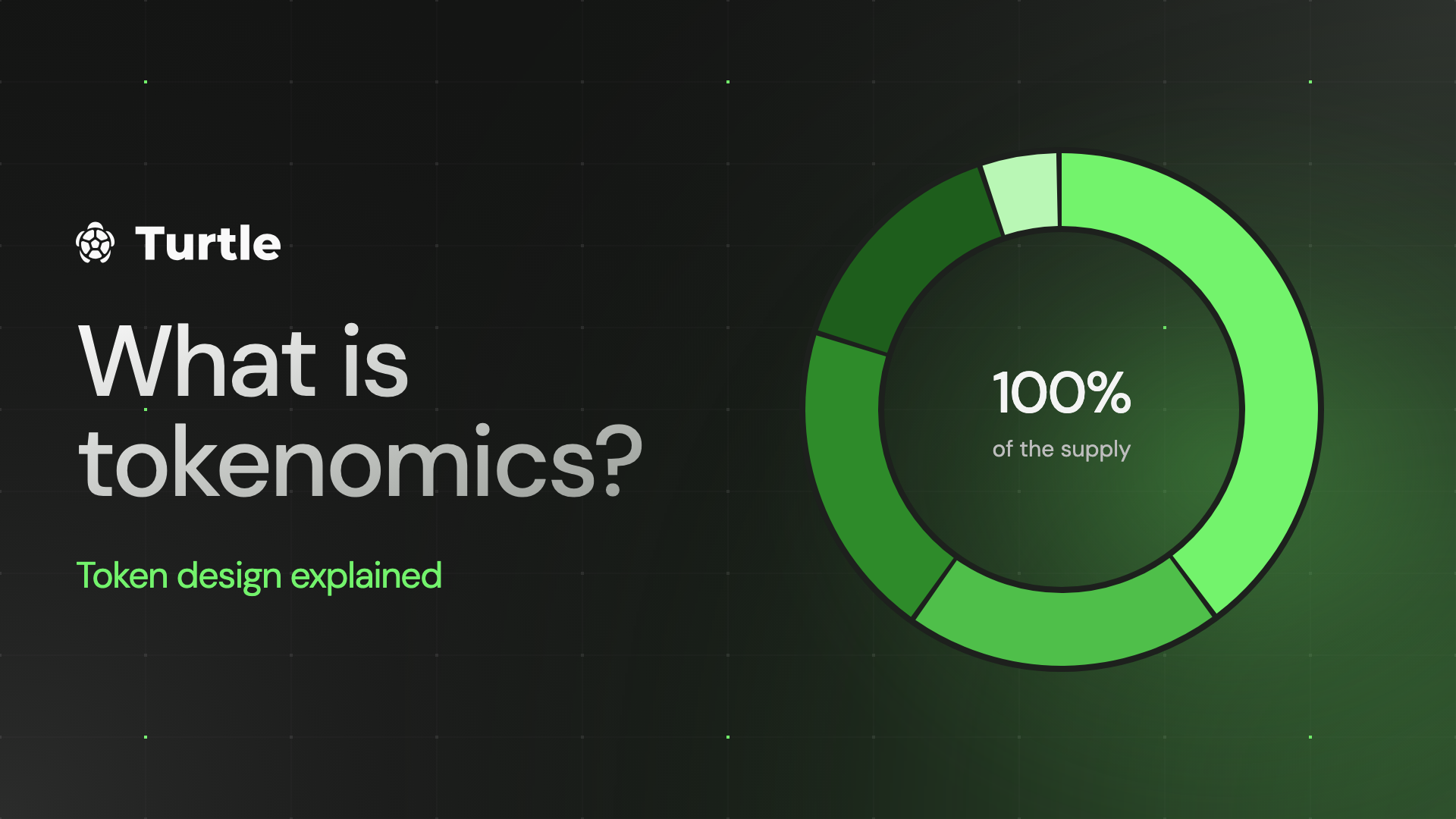
Allocation is how the initial supply is split between groups. A typical model reserves shares for the team, early investors, a treasury, the community and incentive programs. Here is an illustrative split, made up to show the idea:
| Group | Share | Typical vesting |
|---|---|---|
| Community and incentives | 40% | Released over several years |
| Treasury | 20% | Spent by governance over time |
| Team | 20% | One-year cliff, then monthly unlocks |
| Investors | 15% | One-year cliff, then monthly unlocks |
| Liquidity and listings | 5% | Available at launch |
Vesting controls when each group can use its tokens. A cliff is a waiting period with no unlocks. After the cliff, tokens usually unlock in equal parts each month or each block until the schedule ends. Vesting aligns insiders with the project's long-term results, and it spreads the arrival of new supply over time.
Why do token unlocks matter?
An unlock is the day a group of vested tokens becomes free to move. It raises the circulating supply, and if the holders sell, the market has to absorb it.
Unlocks are public in most token documents, so you can check them before they happen. Look at:
- Size: the unlock as a share of the current circulating supply.
- Recipients: team and early investors often hold tokens bought at a lower price.
- Pace: one large cliff unlock adds supply at once, and a linear schedule spreads it out.
An unlock does not decide the price on its own. Demand from users, buybacks or new utility can absorb new supply, and a small unlock can still move a token with thin liquidity.
How do token incentives fit into tokenomics?
Incentives are often the largest line in a token budget. Protocols pay tokens to liquidity providers, depositors and stakers to bring capital and activity, and every token paid out adds to the circulating supply.
How those incentives are designed decides what the protocol gets for its emissions. Rewards that pay for a deposit on day one and nothing after tend to attract capital that leaves when the rewards end, a pattern known as mercenary capital. Teams that want capital to stay tie rewards to how long it stays and cap what they spend. Turtle covers the design steps in how to design a liquidity mining campaign.
Turtle Streams, Turtle's incentive distribution product, puts those controls into each campaign (Turtle docs):
- Pay in tokens or points. A stream can pay an ERC-20 token or points that convert at a future TGE, so a team can reward users before its token launches.
- Pay for TVL held. TVL-based streams pay holders continuously against their balance. A Fixed Rate pays a set amount of tokens per 1,000 USD of TVL per day.
- Cap the spend. A Daily Budget splits a fixed amount each day across all LPs, so spend stays capped however much liquidity arrives (Turtle docs).
- Reward commitment. Deposit-based streams pay through duration tiers that unlock at cliffs, and a depositor who leaves before a cliff forfeits that tier's unvested rewards.
- Verify every payout. Each stream holds its own funds, and each distribution is committed onchain as a Merkle root. The contracts are non-custodial and were audited in January 2026.
A stream costs a one-time creation fee plus the reward budget the protocol funds (Turtle docs). If you are planning a token incentive program, you can start a stream at streams.turtle.xyz.
How do you evaluate a project's tokenomics?
Read the token documents with these questions in mind:
- Supply: is there a maximum supply, and how far is the circulating supply from it?
- Allocation: what share goes to insiders, and what share goes to users and incentives?
- Vesting: how long are the cliffs, and when are the next large unlocks?
- Emissions: how many new tokens enter each year, and what does the protocol get for them?
- Utility: does the token have a use inside the product, such as fees, staking or governance?
- Value capture: do burns, buybacks or fee sharing link the token to the protocol's revenue?
- Concentration: how much of the supply sits in a few wallets?
Tokenomics shows how a token is built. It does not predict a price, and a well-designed token can still fail if the product does not find users.
FAQ
Is tokenomics the same as token economics?
Yes. Tokenomics is short for token economics, and both terms describe the rules for a token's supply, distribution, use and value. In AI, tokenomics also refers to the cost of the tokens a language model processes, which is a separate topic.
What makes tokenomics good?
Good tokenomics ties emissions and allocations to behavior the protocol needs, spreads unlocks over time, gives the token a real use and links it to the protocol's revenue. Transparent documents that show every allocation and unlock date are also a good sign.
What is fully diluted valuation (FDV)?
FDV is the maximum supply of a token multiplied by its current price. It shows what the token would be worth at today's price if every token existed and circulated. Compare it with market cap to see how much supply is still to come.
What is a token unlock?
A token unlock is the release of vested tokens to their holders, often team members, investors or the treasury. It raises the circulating supply on a known date, and token documents usually publish the full unlock schedule.
Are inflationary tokens bad?
Not by themselves. An inflationary token releases more tokens than it burns. That can fund security, liquidity or growth. The question is whether the new supply pays for something the protocol needs and whether demand keeps up with it.
Are points part of tokenomics?
Often, yes. Many protocols run points programs before their token launches and convert the points into tokens at the TGE. The conversion rate and the share of supply reserved for points are part of the token's allocation.